Gut-Brain Axis: How your Diet Explains your Mood
- Maryam Adegboyega
- 1 day ago
- 4 min read

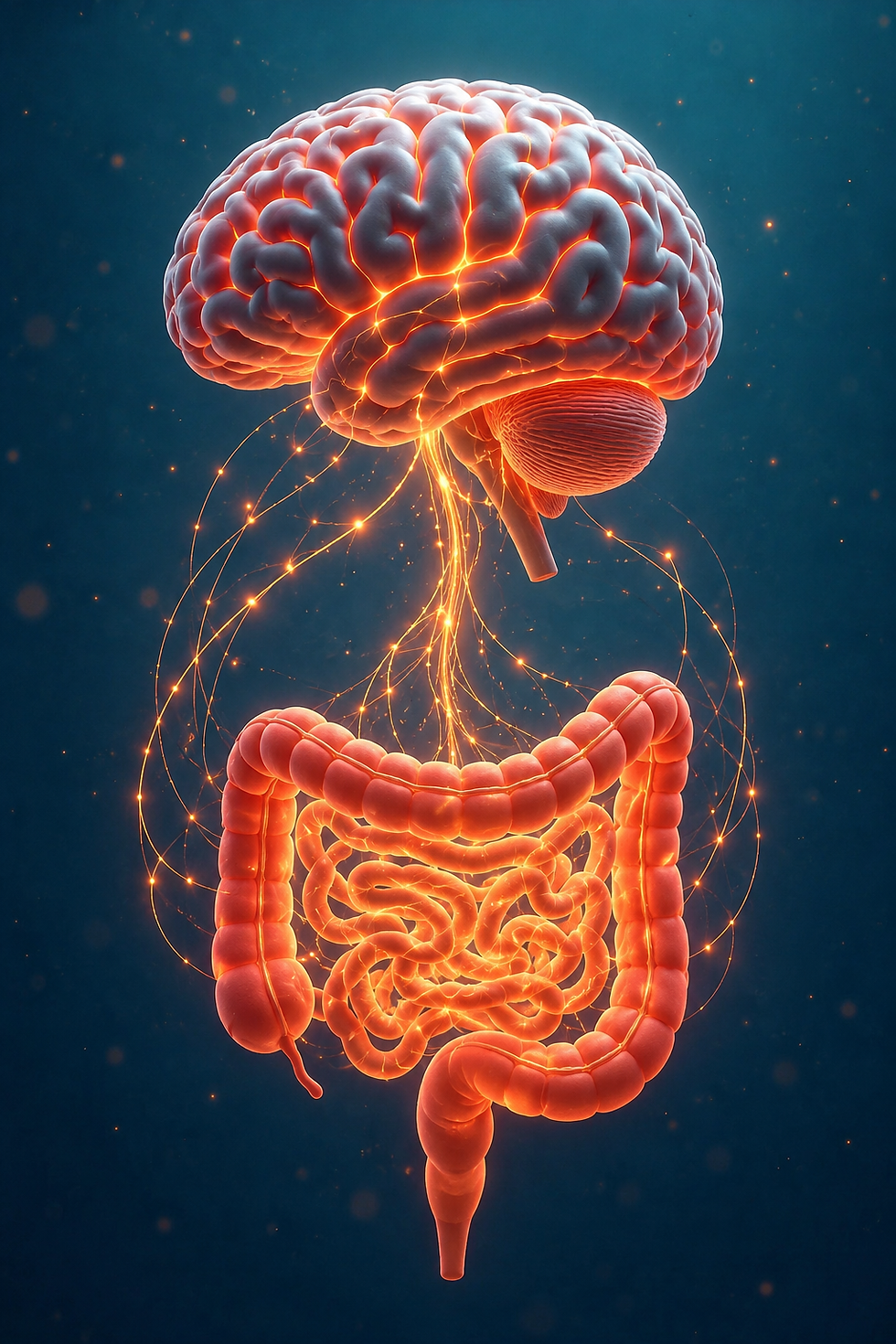
Do you ever eat chocolate and instantly feel good?
Or a cup of coffee in the morning, and you feel like your brain just got fully charged and ready to take on the day?
This article explains the brain-gut axis, the biological mechanism by which our diet shapes how we feel and how to optimise it for everyday wellness and mental health.
What is the brain-gut axis?
The brain-gut axis connects the gastrointestinal system, consisting of the mouth, stomach and intestines, with the central nervous system in a two-way communication system that greatly impacts our health and overall well-being.
The communication is facilitated through a series of neurons, hormones and immune pathways. In the gut, there are millions of microorganisms collectively called the gut microbiome. Recent scientific breakthroughs suggest that microorganisms in the gut also play an important role in the brain-gut axis. Their role is so important that they are often termed the second brain. Scientists have discovered that the gut microbiome influences the development and function of the brain throughout the lifetime; they directly affect mood, cognition, emotions and overall mental health. Gut microorganisms can be beneficial or pathogenic. Scientists found that an imbalance in the gut microbiome is linked with anxiety and depression.
Gut Microbes: microscopic soldiers in the brain-gut axis
Gut microbes interact directly with the brain through 4 primary mechanisms.
Through neural pathways: The gut is lined with what is known as the Enteric Nervous System. Microbes stimulate this lining, sending rapid signals to the brain through the vagus nerve about the gut condition, stress and overall gut activity.
Neurotransmitter Production: Beneficial gut microbiomes produce neurochemicals, some of which are known as the happy juices. These include serotonin for regulating mood and sleep, GABA to reduce anxiety, dopamine and norepinephrine.
Metabolite Signalling: During the digestion of fibre-rich foods, the beneficial microbes ferment dietary fibres to produce Short Chain Fatty Acids, SCFA for short. SCFAs help maintain the blood-brain barrier and also help reduce inflammation in the nervous system. They also play a role in regulating immune cells in the brain.
Immune regulation: Chronic, low-grade inflammation is often linked to psychiatric and neurodegenerative disorders. The good gut microbiome helps prevent this inflammation by interacting with gut immune cells and managing biological symptoms.
Optimising the gut for mental health
You better believe it when they say “You are what you eat” because the composition of our gut microbiome is usually a result of what we eat. For this reason, gut microbiome-targeted approaches, such as probiotics and prebiotics, have become popular for improved mental well-being.
Probiotics are live beneficial bacteria often found in fermented food like yoghurt. They develop during the fermentation process, creating friendly microbes such as Lactobacillus plantarum and Leuconostoc mesenteroides. These bacteria promote gut health, improve digestion and support the immune system through their activities in the brain-gut axis.
Prebiotics, on the other hand, are food materials that feed the friendly microorganisms, helping them to thrive and multiply. Here are food classes that are excellent sources of prebiotics.
Alliums

This group includes garlic, onions and leeks. They are rich in inulin, a dietary fibre which is fermented by the beneficial gut bacteria into short-chain fatty acids. Inulin has been reported by research to boost cognitive function, improve mood, regulate anxiety and protect against neurodegenerative diseases such as Alzheimers and post-stroke depressive behaviours.
Root Vegetables and Tubers

Yam, cassava, and potatoes belong to the class of root vegetables and tubers. They are rich in resistant starch. Resistant starch cannot be readily digested by the human body, but serves as food for the gut microbiome.
Vegetables

Both leafy and cruciferous vegetables are excellent sources of fibre. Fibre is an important food source for the gut microbiome
Polyphenol-Rich foods
Polyphenols selectively encourage the growth of beneficial bacteria while suppressing pathogenic ones. Polyphenol-rich foods include green tea, chocolate, coffee, olive oil and fruits.
Aside from natural sources of probiotics and prebiotics found in food, there are also probiotic supplements. Probiotic supplements are becoming increasingly popular, driven by consumers’ demand for immunity and mental health support.
It is important to note that stress and the brain can affect the gut environment in the same way the gut environment or microbes can alter brain activity and mood. Supporting a healthy brain-gut axis requires consuming diverse probiotic and probiotic-rich foods.
Sources
Gut over Mind: Exploring the Powerful Gut–Brain Axis. https://pmc.ncbi.nlm.nih.gov/articles/PMC11901622/
The Brain-Gut Connection. https://www.hopkinsmedicine.org/health/wellness-and-prevention/the-brain-gut-connection
The Gut-Brain Axis and Mental Health: How Diet Shapes Our Cognitive and Emotional Well-Being. https://pmc.ncbi.nlm.nih.gov/articles/PMC12366197/
How the gut-brain connection influences mood. https://www.health.harvard.edu/digestive-health/how-the-gut-brain-connection-influences-mood
Li, K., Wei, W., Xu, C., Lian, X., Bao, J., Yang, S., Wang, S., Zhang, X., Zheng, X., Wang, Y., & Zhong, S. (2024). Prebiotic inulin alleviates anxiety and depression-like behavior in alcohol withdrawal mice by modulating the gut microbiota and 5-HT metabolism. Phytomedicine : international journal of phytotherapy and phytopharmacology, 135, 156181. https://doi.org/10.1016/j.phymed.2024.156181
Hoffman, J. D., Yanckello, L. M., Chlipala, G., Hammond, T. C., McCulloch, S. D., Parikh, I., Sun, S., Morganti, J. M., Green, S. J., & Lin, A. L. (2019). Dietary inulin alters the gut microbiome, enhances systemic metabolism and reduces neuroinflammation in an APOE4 mouse model. PloS one, 14(8), e0221828. https://doi.org/10.1371/journal.pone.0221828
Shao, R., Tan, X., Pan, M., Huang, J., Huang, L., Bi, B., Huang, X., Wang, J., & Li, X. (2024). Inulin alters gut microbiota to alleviate post-stroke depressive-like behavior associated with the IGF-1-mediated MAPK signaling pathway. Brain and behavior, 14(1), e3387. https://doi.org/10.1002/brb3.3387
Chen, Z., Liang, N., Zhang, H., Li, H., Guo, J., Zhang, Y., Chen, Y., Wang, Y., & Shi, N. (2024). Resistant starch and the gut microbiome: Exploring beneficial interactions and dietary impacts. Food chemistry: X, 21, 101118. https://doi.org/10.1016/j.fochx.2024.101118
Fu, J., Zheng, Y., Gao, Y., & Xu, W. (2022). Dietary Fiber Intake and Gut Microbiota in Human Health. Microorganisms, 10(12), 2507. https://doi.org/10.3390/microorganisms10122507
Wang, X., Qi, Y., & Zheng, H. (2022). Dietary Polyphenol, Gut Microbiota, and Health Benefits. Antioxidants (Basel, Switzerland), 11(6), 1212. https://doi.org/10.3390/antiox11061212


Comments